
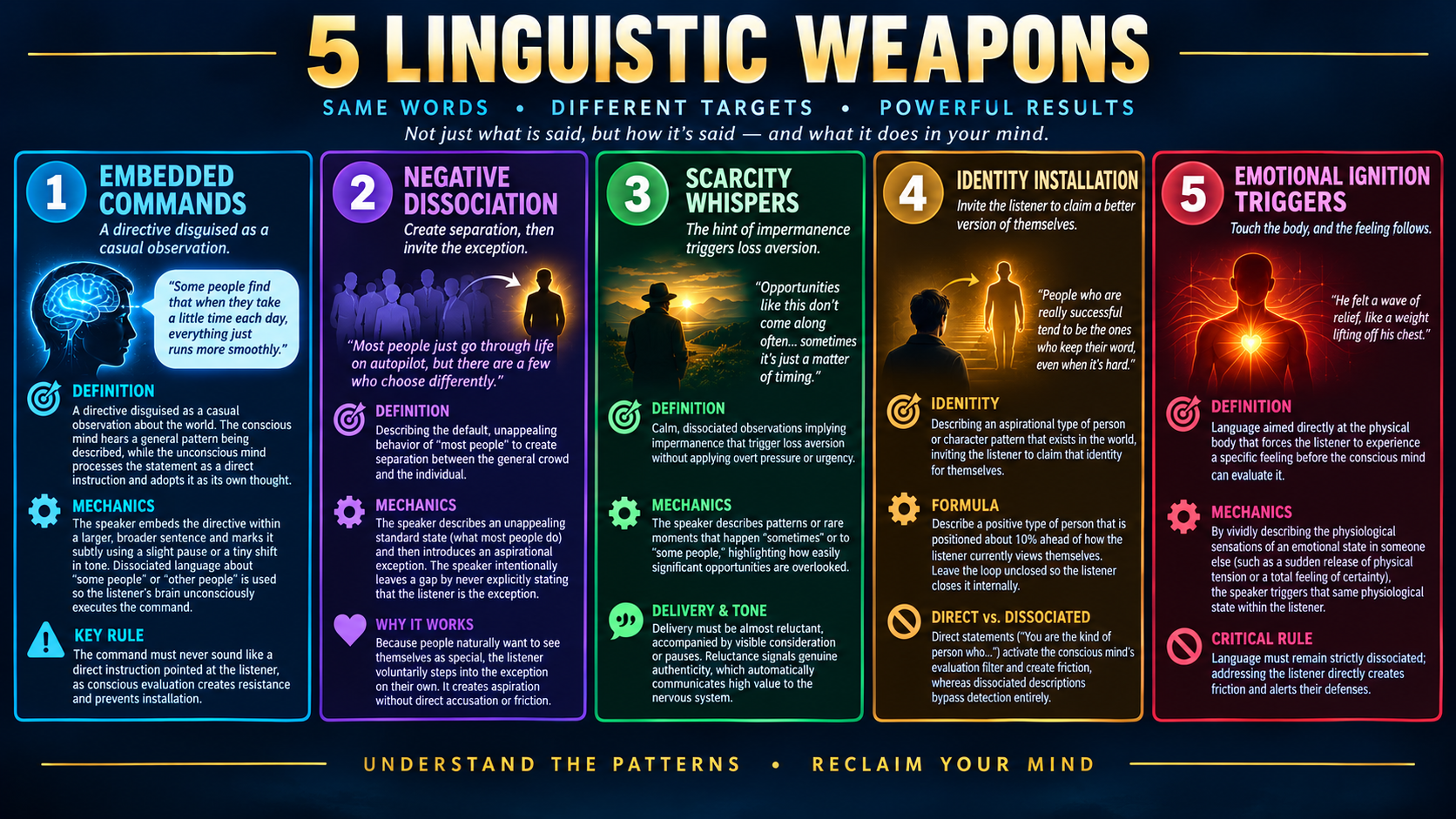
The Five Linguistic Weapons
Weapon #1: Embedded Commands
Embedded commands hide instructions within seemingly ordinary statements. The subconscious mind processes language differently than the conscious mind—it responds to these hidden directives without the conscious mind ever noticing.
The key is using “loose” phrasing—phrases like “some people,” “one can,” or “you might find”—and then slipping in the command. For example:
“Some people find that when they relax completely, their attention naturally sharpens.”
The bolded portions are embedded commands. Hughes emphasizes that the way to master this is to practice in front of a mirror until these sentence structures become second nature.
Weapon #2: Negative Dissociation
Negative dissociation shapes behavior indirectly by describing “someone else.” You talk about what other people do, but the listener unconsciously compares themselves to that description and chooses to become the opposite.
“Have you ever noticed how so many people just go through life on autopilot? Like they’re running a script someone else told them was what they were supposed to do.”
When you say this, the person doesn’t think “I’m like that.” Instead, they automatically distance themselves from the described image. Negative dissociation leverages people’s resistance to becoming a certain type of person, steering them toward the behavior you want.
Weapon #3: Scarcity Whispers
Scarcity whispers evoke a sense of impermanence and urgency. They don’t directly say “limited-time offer”—instead, they create a “miss it and it’s gone” feeling through implication.
“Some moments you don’t realize are important until later—and by then you understand that moments like that almost never come again.”
Scarcity works because loss framing is more motivating than gain framing. When people perceive something might disappear, their decision mode shifts from “do I need this” to “will I lose this.”
Weapon #4: Identity Installation
Identity installation describes an aspirational type of person, creating a desire to become that person. Humans crave internal consistency—once you identify as a certain type of person, your behavior automatically aligns with that identity.
“You know what the truly successful people have in common? They have this incredible ability to completely focus in the moment.”
On the surface, this is about successful people. In reality, it plants an identity goal in the listener: a person who can completely focus. Once they identify with that, focused behavior follows naturally.
Weapon #5: Emotional Ignition Triggers
Emotional ignition triggers activate emotional states by describing physical sensations. Body and emotion are bidirectionally connected—when you describe a physical feeling, the listener unconsciously experiences the corresponding emotion.
“When it finally clicks, it’s like something just releases. You can feel your shoulders drop, and everything suddenly becomes clear.”
By pointing to specific body parts and sensations, you help the listener “rehearse” that emotional state at a physical level. Once the bodily experience is activated, the emotion follows.
Weapon Chains: The Power of Combination
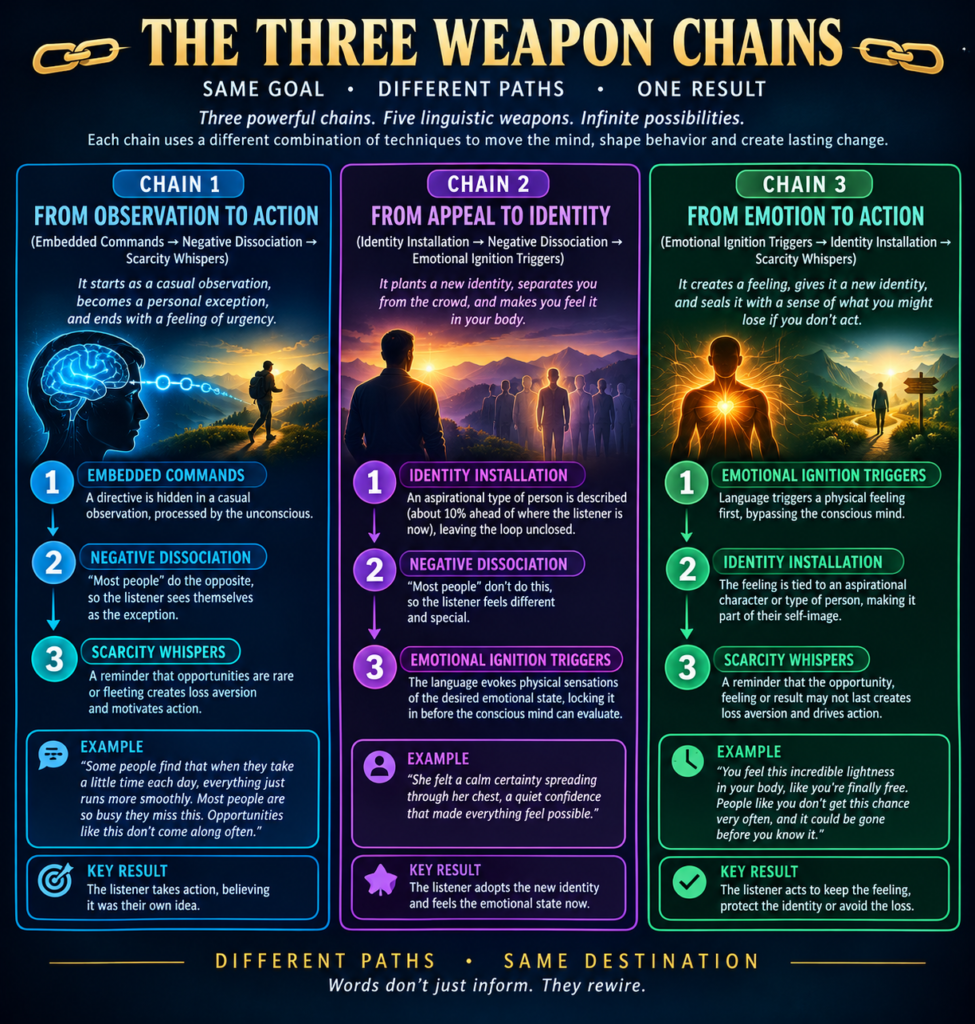
Using one weapon alone is effective. But chaining multiple weapons together creates exponential impact. Hughes outlines three core chains in his “90-Second Control Map.”
Chain #1: Embedded Command → Negative Dissociation → Scarcity Whisper
This chain works well when you need to quickly establish focus and urgency. For example, at the start of a training session:
“Some people get a special kind of clarity (embedded command), like something important is about to happen, and they naturally focus in. Meanwhile, there are so many people out there who are just on autopilot every single day (negative dissociation), living out a script someone else wrote. But some experiences, once missed, are truly gone (scarcity whisper)—that state of complete engagement, you almost never get a second chance at it.”
Chain #2: Identity Installation → Negative Dissociation → Emotional Ignition
This chain suits motivating and guiding long-term behavior change. For example, in a coaching conversation:
“The truly elite athletes have one thing in common—they can block out all distraction in the critical moment (identity installation). They’re not like those people who are forever scattered (negative dissociation), pulled around by every notification and stray thought. And when they enter that state, you can see their whole body change—breath deepens, eyes narrow, as if time itself stops (emotional ignition).”
Chain #3: Emotional Ignition → Identity Installation → Scarcity Whisper
This chain suits deepening commitment in sales or negotiation contexts:
“Have you ever had that feeling—right there in your gut, a voice telling you ‘this is right’ (emotional ignition)? The people who make the best decisions are the ones who trust that intuition (identity installation). And this kind of opportunity, frankly, won’t come around a second time (scarcity whisper).”
Why Understanding This Matters
These techniques are neutral in themselves. They can be used to help others or to manipulate them. The key difference lies in intent and transparency.
The practical value of understanding linguistic weapons is recognition. When you hear a phrase like “some people find…” you’ll know it might not be casual conversation. When you feel a sudden sense of urgency, you’ll ask yourself: Is this urgency real, or was it installed?
Research by Rodriguez-Carballeira and colleagues shows that the core features of manipulative communication include isolation, information control, and emotional abuse. Recognizing these patterns is the first step to resisting them.
Relevant Resources
The Behavior Operations Manual by Chase Hughes — Published by Evergreen Press, 2024. ISBN: 9781735141640. The core textbook for systematically learning the FATE model, the Six-Axis Model of Influence, and linguistic weapons. Here is the amazon link: https://amzn.to/4v7Nj81
NLP and Milton Erickson Language Pattern Cards — Full text available via the Internet Archive, containing 52 classic language patterns with practical examples.
Chase Hughes on The Diary of a CEO — An in-depth discussion of the Perception, Context, and Permission (PCP) model and practical applications of negative dissociation. https://youtu.be/RvjR9GM2kX8
International Cultic Studies Association Journal — Provides academic research on scarcity priming and manipulative communication.
#LinguisticWeapons #SubconsciousInfluence #BehaviorOpsManual #ChaseHughes #NLP #CommunicationSkills #PersuasionPsychology #CognitiveBias









Leave A Comment
You must be logged in to post a comment.