
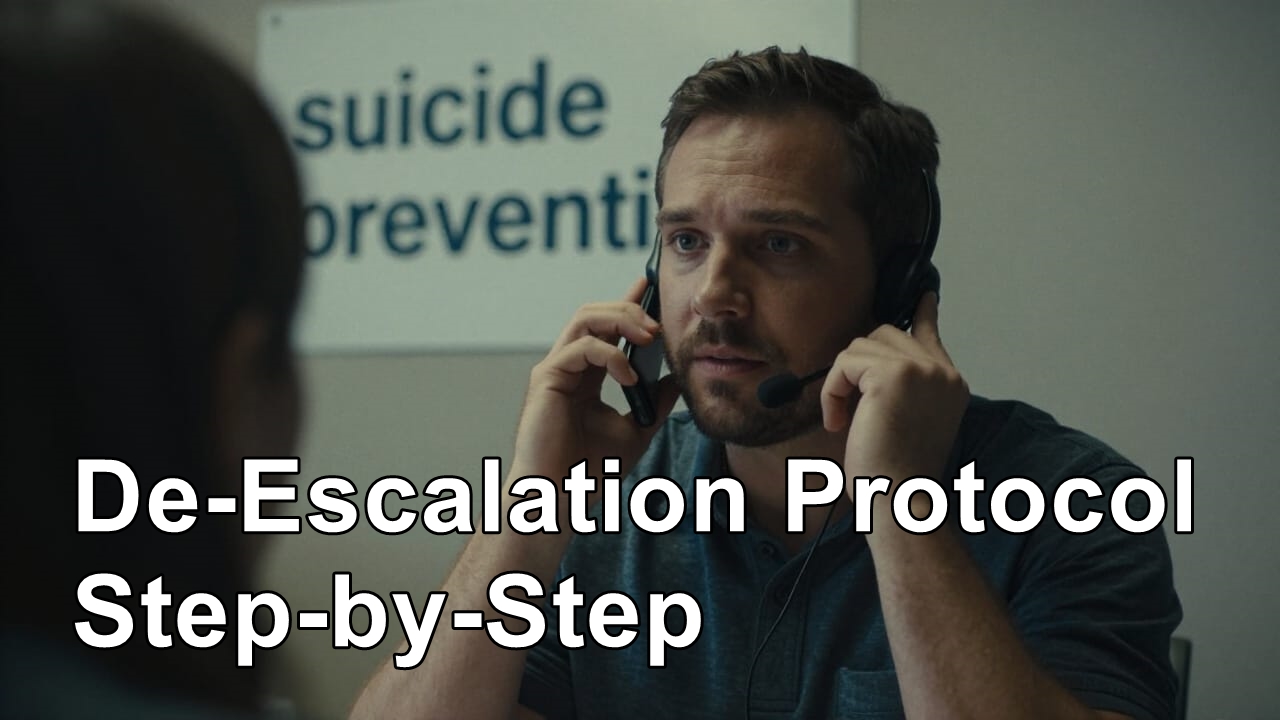
🧠 How to De-Escalate Intense Emotional Situations
Download the Step-by-Step PDF Guide HERE.
A Practical, Psychology-Based Process for Real-World Crisis Moments
 When emotions spike, logic shuts down.
Whether it’s an argument, a crisis call, a heated negotiation, or a moment of internal collapse, the human nervous system can quickly move into survival mode. In that state, reason does not persuade. Pressure does not help. Control backfires.
De-escalation is not about dominance.
It is about alignment with how the mind actually works.
What follows is a simple, repeatable process grounded in sensory processing, social identity, and agency restoration. It works in hostage negotiation, suicide prevention, customer conflict, and everyday human interactions.
🔍 Why De-Escalation Works
Under stress, the brain shifts away from the prefrontal cortex and into emotional and survival circuitry. When this happens:
- 🧠 Cognitive flexibility drops
- ⚠️ Threat perception increases
- 🔒 Resistance becomes automatic
De-escalation works by:
- Matching the person’s internal experience
- Grounding them in external reality
- Restoring choice and control
This process does not require force, authority, or persuasion. It requires precision.
🧩 Step 1: Name Them and Acknowledge Their Emotional State
🎯 Purpose: Establish safety and rapport.
Begin by saying the person’s name. This signals recognition and presence. Then match their dominant sensory processing style, also known as VAK:
- 👁️ Visual: “I see…”, “Look…”, “It’s clear…”
- 👂 Auditory: “I hear…”, “It sounds like…”
- ✋ Kinesthetic: “I feel…”, “This feels heavy…”
If you are unsure, default to visual. Roughly 80% of people process primarily through imagery.
Next, accurately label the emotional state and normalize it.
Example:
“John, I can see you’re frustrated. You’re annoyed. I understand. Anyone would feel this way in your position.”
This is not agreement with behavior. It is agreement with experience.
🧠 The nervous system relaxes when it feels understood.
🧱 Step 2: State Three Neutral, Verifiable Facts
🎯 Purpose: Pace reality and interrupt emotional spirals.
Once rapport is established, gently shift attention outward by stating three simple facts that are unquestionably true.
Examples:
- “It’s close to the weekend.”
- “We’re both here right now.”
- “You’re still breathing.”
These facts do not need to be meaningful. They need to be undeniable.
This works because the brain cannot argue with reality while simultaneously escalating emotionally. The emotional momentum slows, and cognitive processing begins to return.
🌍 Reality is stabilizing.
🪞 Step 3: Reflect Their Social Values
🎯 Purpose: Restore identity and meaning.
 Intense emotional states often collapse identity into a single moment. This step expands it again.
Say their name and reflect positive social values you perceive, such as:
- Significance
- Acceptance
- Approval
- Being cared for (pity)
- Strength
- Intelligence
If you are unsure, default to Significance and Acceptance.
Example:
“John, people care about you. You matter more to more people than you realize.”
This reconnects the individual to a broader sense of self beyond the crisis.
❤️ Identity stabilizes behavior.
🧭 Step 4: Return Control and Agency
🎯 Purpose: Reduce power struggles and helplessness.
Escalation thrives on the belief that control has been lost. This step reverses that belief.
Clearly state that what happens next is their choice.
Example:
“What happens now is entirely up to you. This is in your hands.”
This removes coercion and dissolves resistance. When people feel control, they stop fighting for it.
🗝️ Choice calms the nervous system.
🚦 Step 5: Offer a Simple, Optional Suggestion Giving Them the Choice
🎯 Purpose: Guide behavior without force. Avoid anything they can react against.
Offer one calm, achievable action framed as an option.
Example:
“One thing you could do right now is take a slow breath and sit down. You decide.”
This creates a path forward while preserving autonomy.
When choice remains intact, compliance becomes natural rather than forced.
🌿 Suggestion works where command fails.
🧠 Why This Process Matters
This de-escalation method is not manipulation.
It is cooperation with the structure of the human mind.
It aligns with:
- Sensory processing (VAK)
- Emotional validation
- Reality pacing
- Identity reinforcement
- Agency restoration
For hypnotists, negotiators, therapists, and everyday people, this process is a reminder of a deeper truth:
🌀 The mind does not calm down when it is controlled. It calms down when it is understood.
🔖 Hashtags
#DeEscalation #Psychology #Hypnosis #HowTheMindWorks #Neuroscience #Influence #EmotionalRegulation #MindControl #NLP #CrisisIntervention






Leave A Comment
You must be logged in to post a comment.